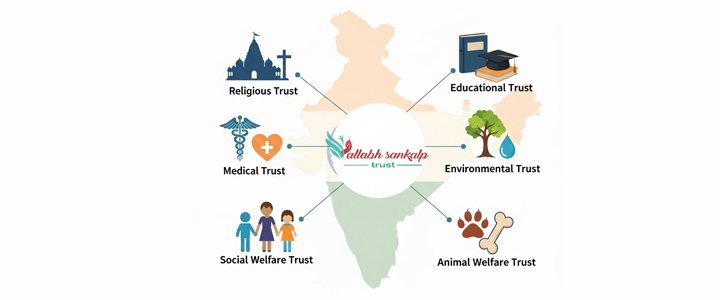
India is rich with a history of giving back through charity, compassion, and social deeds. The timeline is dotted with individuals and communities who have founded numerous charitable trusts for the betterment of society and to serve the less fortunate. From the promotion of education to healthcare provision, women empowerment to the support of the underprivileged, charitable trusts have been the lifeblood institutions that resoundingly contribute to a better nation.
The article “Different Types of Charitable Trusts in India” by Vallabh Sankalp Trust enlightens you with the categories of charitable trusts, their purposes, and their operations if you have ever been curious about how many types of charitable trusts are there in India.
What is a Charitable Trust?
A charitable trust is a legal entity that is non-profit and is created to support educational, religious, or social causes of humanity. It is about the donation of property, money, or assets by a donor (settlor) to trustees, who will use and manage the donation in the most beneficial way for the charitable purposes.
Charitable trusts in India are functioning under the laws, which are the Indian Trusts Act, 1882 (for private trusts) and The Charitable and Religious Trusts Act, 1920 (for public charitable trusts). Such trusts are usually given exemptions from some taxes under Section 12A and 80G of the Income Tax Act, which makes them the most favorable structures for social initiatives.
Types of Charitable Trusts in India
In India, the different kinds of charitable trusts could majorly be divided into two key groups – Public Charitable Trusts and Private Charitable Trusts. We will analyze each type individually:
Indian charitable trusts are either public or private. Each of them has a distinct and separate function in the society. Public trusts are the ones, which are funded and run by the public. On the other hand, private trusts are those which are started by individuals or a group and funded by them. Some of the different types of public charitable trusts in India are educational, religious, medical, orphans and widows, animal welfare trusts, etc. Similarly, there are four major types of private charitable trusts to be found in India.
1. Public Charitable Trusts
One example of a public charitable trust is the type of trust that aims at benefiting the entire community or a big portion of society. Such initiatives include providing quality education, healthcare services, eradicating poverty, and improving overall community welfare.
Public charitable trusts are nonprofit entities and thus enjoy tax benefits and other incentives granted by the government. Eligible organizations under the Charitable and Religious Trusts Act 1920 must devote all income and assets to the exclusive use of charitable activities.
Examples of Public Charitable Trusts:
- Educational trusts that support primary education and provide scholarships to children from economically weaker sections of society.
- Medical trusts that arrange health camps and hospitals for marginalized people.
- Religious and cultural trusts that support spiritual education and promote values like love, peace, and unity.
Vallabh Sankalp Trust is India’s Public Charitable Trust setting an excellent example, endeavoring extensively in the fields of education, women empowerment, healthcare, and community welfare.
2. Private Charitable Trusts
Private Charitable Trusts refer to those funds that benefit specific people or a clearly defined group instead of the general public. The beneficiaries are already known and the public is not included among them.
Generally, these kinds of trusts are designed to support families or specific social causes chosen by the founder. Even though they can be involved in social welfare activities, they do not qualify for the tax exemptions granted to publicly charitable trusts.
Example:
Say the trust is set up to shoulder the educational expenses or to provide a monetary grant solely to the founder’s family members or a particular community, then it will be considered as a private charitable trust.
Other Common Classifications of Charitable Trusts in India
Besides the categories mentioned above, charitable trusts also can be divided based on the purpose and work. Below are some of the widely accepted forms:
1. Educational Trusts
Such trusts concentrate mainly on education, literacy, and the acquisition of skills. They may operate schools, colleges, vocational centers, or establish scholarship programs for the students who are in need and have merit.
Example: Vallabh Sankalp Trust manages educational programs in the schools of the underprivileged children and promotes literacy in the rural areas.
2. Religious or Spiritual Trusts
These trusts help the progression of religious ideals by constructing temples, organizing spiritual meetings, and spreading good moral values. In addition, they may donate food through the distribution of free meals or conduct medical camps and offer medicines without cost to the patients.
3. Medical or Healthcare Trusts
The mission of the medical trusts is to improve people’s health through stay free medical camps, hospitals, and awareness drives. Several times they give medicine free of charge, support patients, and provide emergency medical services if needed.
Example: Vallabh Sankalp Trust actively organizes health check-up camps and is involved in donating medical supplies to the areas which are not well off.
4. Women Empowerment Trusts
Works through the provision of vocational training, entrepreneurship, and education programs for women, these trusts aim at their rise. The implementation of Women rights and the provision of women financial resources are among their activities.
Example: Vallabh Sankalp Trust implements diversified skill development programs which provide the potential of self-reliance to women.
5. Environmental and Social Welfare Trusts
Such charities have causes and issues like environment conservation, poverty eradication, sanitation, and community development at their disposal. They practice and perform different activities like tree plantation, waste management, and awareness campaigns to achieve their goals.
6. Orphan and Old Age Care Trusts
These trusts that focus on the giving of support and care to orphans, homeless children, and elderly people provide the basic necessities such as food, shelter, and emotional care to those who lack a family.
7. Disaster Relief and Emergency Trusts
These organizations which can be understood as rescue groups or emergency services provide help for those who suffer from natural calamities, pandemics, or any other kind of emergency in the shortest possible time. They respond to a crisis condition with efforts such as food distribution, providing shelter, and organizing medical treatments.
The Legal Framework for Charitable Trusts in India
In order to maintain transparency as well as accountability, the charitable trusts in India are regulated by the well-defined legal framework. The essential laws and registrations include:
- Indian Trusts Act, 1882: A law that regulates the origin and administration of private trusts.
- Charitable and Religious Trusts Act, 1920: A law that regulates public charitable trusts.
- Section 12A and 80G Registration (Income Tax Act): A registration that grants tax benefits to donors and the charity.
- NGO Darpan Registration (NITI Aayog): A registration that allows the NGO to collaborate with the government schemes.
Why Vallabh Sankalp Trust Stands Out Among Charitable Trusts in India
Vallabh Sankalp Trust is more than just a registered charitable organization. It is a movement that is led by the core values of compassion and responsibility. The trust, which is located in Lucknow, has broadened its scope through the various impactful initiatives in education, healthcare, women empowerment, and community service.
Key Features of Vallabh Sankalp Trust:
- The money received from donors is used for verified charitable causes with full transparency.
- Its programs encompass not only education but also health and welfare of the society.
- The trust cooperates with both volunteers and local communities.
- The main aim is not on immediate but rather long-term effects of creating self-reliant individuals and sustainable communities.
Conclusion: The Many Faces of Charity in India
The numerous charitable organizations in India that abide by the principle of “Seva Parmo Dharma”— service is the highest duty—form the country’s social fabric. Among these are educational and medical trusts, women empowerment and social welfare foundations, to name a few; each taking a distinct step in the journey of changing lives.
Nevertheless, if you were to pick out the best charitable trusts in India that not only make the difference but also genuinely win the hearts, Vallabh Sankalp Trust would be that one. It symbolizes hope, service, and humanity.
It is through the varied programs and also open dealings that Vallabh Sankalp Trust goes on to show that charity, if done with honesty and foresight, has the power to build a stronger and more compassionate nation.