Types of Non Governmental Organization: Understanding NGOs and Their Role in Society – Vallabh Sankalp Trust
Introduction
Non-Governmental Organizations (NGOs) are crucial in solving social, economic, environmental, and humanitarian problems worldwide. By definition, NGOs are not under government control and they work to improve the lives of communities, marginalized groups, and society in general. Knowing about different forms of non governmental organization is very helpful for people, donors, volunteers, and companies that want to support social causes in an effective way.
Vallabh Sankalp Trust is of the opinion that NGOs can be used as the instrument for bringing about a positive change. Be it education, healthcare, environmental conservation, or community development, each NGO has its own role in the future building process.
We shall discuss in this post the various forms of non governmental organization, their purpose, and their roles in social development.
What Is a Non Governmental Organization?
A Non-Governmental Organization (NGO) is a non-profit organization that a person or a group of people set up to resolve issues related to society, environment, education, healthcare or to help those in need. NGOs are independent from government bodies and in the majority of cases, they depend on donations, grants, memberships, and volunteer help for their survival.
NGOs’ main goal is to contribute towards building a better society while at the same time ensuring environmental sustainability and the realization of social justice.
Why Are NGOs Important?
Knowing about different types of non governmental organization is a good thing, but it is even better to understand the importance of NGOs.
Why NGOs Matter
- Assist disadvantaged populations
- Enhance education and healthcare
- Guard the environment
- Help women and children to become independent
- Offer disaster relief and humanitarian aid
- Speak out for the defense of human rights
- Lead social and economic development efforts
Institutions such as Vallabh Sankalp Trust are committed to changing people’s lives for the better through different welfare programs and community development efforts.
Different Types of Non Governmental Organizations
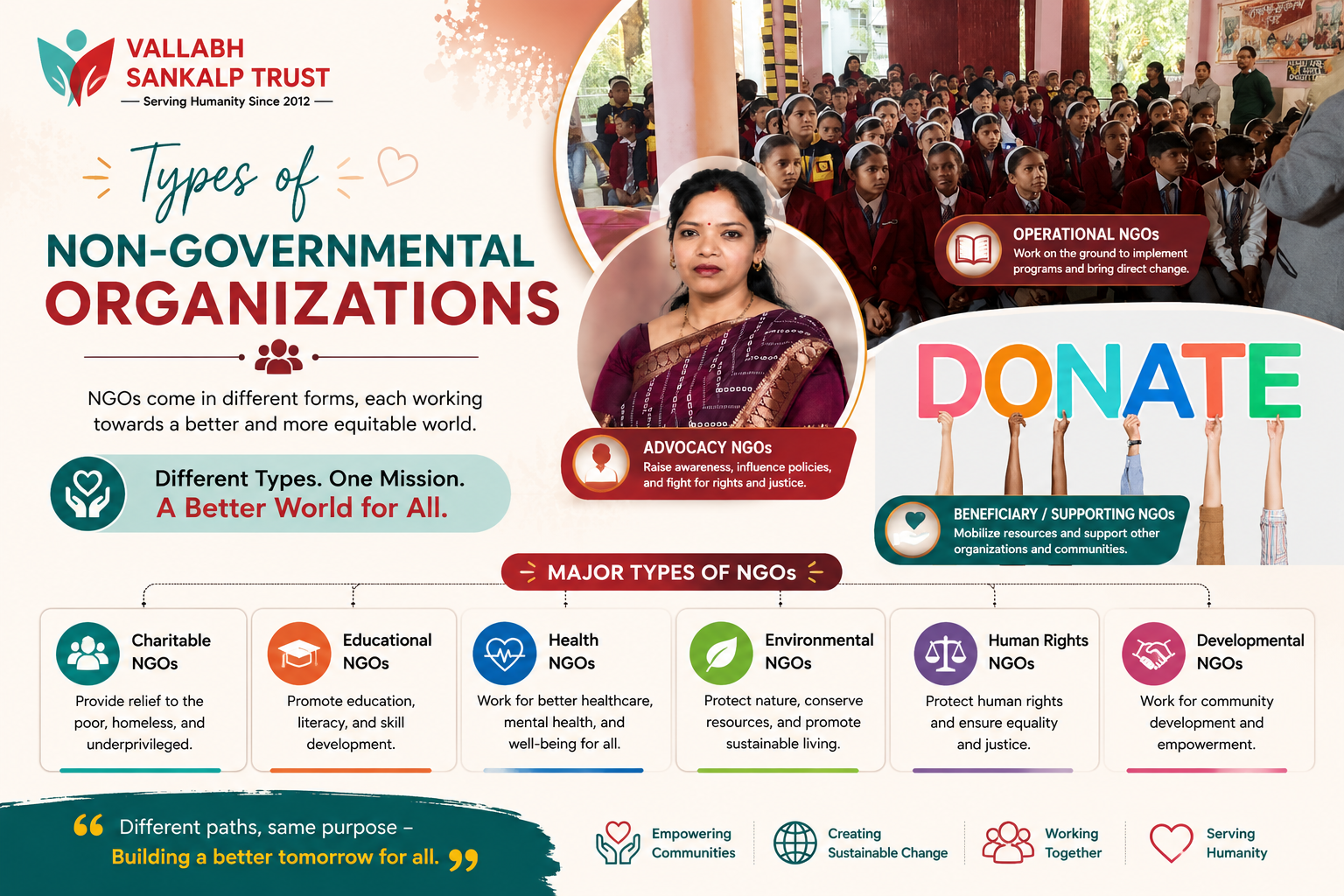
NGOs can be categorized according to their goals, internal organization, and extent of work. Here are the main types of non governmental organization that exist in the world.
1. Charitable NGOs
Charitable NGOs are mainly concerned with offering immediate help to the needy. Their activities could be distributing food, clothes, medicines, providing educational support and giving out money.
Main Actions
- Food donation campaigns
- Organizing medical camps
- Providing educational scholarships
- Running poverty reduction programs
- Supplying disaster relief materials
For example, Vallabh Sankalp Trust is a charitable organization that engages in activities aimed at uplifting the lives of disadvantaged people.
2. Service-Oriented NGOs
The service-oriented NGOs are those which provide certain community services. These could be things like healthcare, education, training in different skills, sanitation, and vocational education.
Types of Services
- Free healthcare services
- Promoting literacy
- Training people in different skills
- Programs for empowering women
- Services for looking after children
Such NGOs collaborate with local populations to solve everyday problems and upgrade the standard of living.
3. Participatory NGOs
Participatory NGOs engage the local people in making decisions and the carrying out of projects. Instead of giving solutions, they motivate people to get involved in activities for development.
Advantages of Participatory NGOs
- Community control of projects
- Produce sustainable results in the long run
- Higher level of local involvement
- Have better results in the projects
These NGOs give communities the power to recognize their own needs and to collaborate in finding solutions.
4. Advocacy NGOs
Advocacy NGOs are committed to impacting the government policies, increasing the public understanding and instigating social changes. They stand for the rights of deprived sections and work to get the spotlight on critical issues.
Advocacy Fields
- Human rights
- Keeping gender equality
- Protection of children
- Preservation of environment
- Justice in the society
Besides raising public awareness and working on policy changes, they also run campaigns to rally the support of the people at large.
5. Environmental NGOs
Environmental NGOs are dedicated to safeguarding our natural world, preserving biodiversity, and encouraging sustainable living.
Popular Environmental Actions
- Organizing tree planting campaigns
- Protecting endangered species
- Engaging communities in waste segregation
- Spreading information about global warming
- Running water preservation drives
These groups significantly contribute to making the planet a better place to live.
6. Educational NGOs
Educational NGOs work to ensure that education is a right and not a privilege by opening the doors of good education to those children and adults who are deprived of it, especially in the remote and backward areas.
Ways to Help Education
- Providing scholarships
- Building and renovating schools
- Helping in e-learning
- Conducting literacy drives for adults
- Organizing teacher skill development sessions
NGOs in the education sector make it possible for a greater number of people to get an education and hence a better life.
7. Healthcare NGOs
Healthcare NGOs contribute towards producing healthy societies by offering health education, treatments, and prevention to the community at large.
What Healthcare NGOs Offer
- Offering free medical screening
- Distributing immunizations
- Supporting childbirth and health of new-borns
- Educating about health and hygiene
- Offering counseling and therapy sessions
They serve as a lifeline especially in rustic and less accessible regions where they reach the people with the most basic and vital health care services through their health camps and mobile clinics.
8. Human Rights NGOs
Human rights NGOs are dedicated to promoting and protecting human rights and freedoms for everyone, irrespective of who they are.
What They Stand for
- Defending children against exploitation
- Advocating for gender equality
- Ensuring fair labor practices
- Helping displaced persons
- Providing legal assistance
In addition to defending, these are often working to strengthen the laws so that the rights of everyone are upheld most effectively.
9. International NGOs (INGOs)
Usually referred to as INGOs, international NGOs mainly conduct operations in many countries and deal with issues at a global level. Poverty alleviation, education of deprived children, health, and disaster preparedness are the common causes dealt by these NGOs.
Features of INGOs
- Have offices and staff spread over different countries
- Implementing large charity projects
- Able to receive donations from several governments and other NGOs
- Working in partnership with other NGOs cross-border
While most of their work is focused on national and international levels, they are also known to extend cooperation to local governments and public along with other smaller NGOs for a more efficient delivery of services.
10. Community-Based Organizations (CBOs)
CBOs are essentially NGOs that are based and work only within a particular community.
Purpose of CBOs
- Community development and betterment
- Local welfare initiatives
- Social awareness campaigns
- Capacity building
Given that they are embedded in the community, they know the needs and problems of the community intimately.
Classification of NGOs Based on Scope
Besides the categories mentioned above, another way to categorize NGOs is by the areas in which they operate.
Local NGOs
Usually serve the inhabitants of a village, town, or city.
National NGOs
Have the capacity to function in different states or regions within the same country.
International NGOs
Their main focus is to implement work and development in different countries of the world.
Such classification enables one to know the magnitude and effectiveness of the work of an entity.
Characteristics of INGOs
- World-wide reach
- Large-scale humanitarian activities
- Mainly funded by international donors
- Partnerships with entities from different countries
Such organizations generally work with public authorities, private sector, and local NGOs to enhance the outcomes.
10. Community-Based Organizations (CBOs)
Community-Based Organizations are small-scale NGOs operating at the very grassroots level.
Objectives of CBOs
- Driving community development
- Local welfare initiatives
- Improving social awareness
- Enhancing skills and capabilities
Due to which, they are fully aware of communities’ needs and problems as the community level is their main area of work.
Classification of NGOs Based on Scope
Besides the above types, NGOs can also be categorized based on the extent of their operations.
Local NGOs
Serve a particular village, town, or city.
National NGOs
Have presence in several states or geographical areas within a country.
International NGOs
Implement projects and activities not only within the home country but also in other countries of the world.
This categorization allows determining the level and the sphere of influence of the organization’s efforts.
How Vallabh Sankalp Trust Contributes to Society
Vallabh Sankalp Trust is a non-profit organization working for the progressive transformation society by implementing various social welfare programs. It mainly supports individuals and community development related activities in the field of education, health, social welfare, and community development.
Key Areas of Focus
- Sponsoring children’s education
- Community welfare initiatives
- Health care awareness program
- Social development projects
- Provision support to the families in need
Vallabh Sankalp Trust is an organization that, through its consistent dedication to corporate social responsibility, is finding ways to continually improve the well-being of people.
How to Choose the Right NGO to Support
Several factors should be considered when deciding on an NGO to support through donations, volunteering, or collaborations:
Transparency
Look into the organization’s financial archives and performance.
Mission Alignment
Select an NGO with objectives in accordance with your principles.
Community Impact
Look at the quantifiable results of their initiatives.
Credibility
Verify the credentials and track record of the organization.
Sustainability
It’s best to donate to organizations that have long-term development plans.
Besides, organizations like Vallabh Sankalp Trust put a strong emphasis on transparency, accountability, and producing a meaningful social impact.
Conclusion
Knowing the different kinds of non governmental organizations enlightens one to the many roles NGOs play in the community. NGOs of different kinds charitable, educational, health, environmental, and advocacy each type has their own significant contribution to the development of the community and to the progress of society.
In its deep sense of social responsibility, Vallabh Sankalp Trust aspires to continue with its commitment to community empowerment through the implementation of impactful initiatives and welfare programs. Each one of us can contribute in the making of a just and compassionate world either by supporting NGOs, volunteering, or creating awareness.”
Together, the main aim is strengthening communities, empowering individuals, and making a better world for tomorrow.
Frequently Asked Questions (FAQs)
1. What are the main types of non governmental organization?
The most common types include charitable, service-oriented, participatory, advocacy, educational, healthcare, environmental, human rights, international, and community-based NGOs.
2. What is the purpose of an NGO?
NGOs aim to solve problems related to social, environmental, educational, healthcare, or humanitarian issues.
3. Are NGOs non-profit organizations?
Indeed, NGOs generally operate on a non-profit basis and are motivated by social welfare rather than profits.
4. What is a charitable NGO?
A charitable NGO is an organization that carries out charity work like giving people food, education, healthcare, and financial support.
5. What are environmental NGOs?
Environmental NGOs are groups that concentrate on issues like conservation, sustainability, climate change, and the protection of natural resources.
6. What do advocacy NGOs do?
Advocacy NGOs mainly promote public awareness and seek to influence legislation concerning social justice, human rights, and community welfare.
7. What is a community-based organization?
A community-based organization is a group that works with people at their level to solve issues affecting them and meet their development needs.
8. How are international NGOs different from local NGOs?
Local NGOs are highly focused on specific communities/areas, whereas international NGOs have a presence in more than one country.
9. Why are NGOs important?
Besides delivering basic services, NGOs also engage in development, uplifting poverty and marginalized sections of society.
10. How does Vallabh Sankalp Trust help society?
The trust is engaged in activities related to education, health, welfare of the society, and socio-economic development.