What Is the Full Form of NGO? Complete Guide by Vallabh Sankalp Trust
Introduction
Most people have heard the term NGO but only a few know its full definition and function in society. Whether you are looking for the complete name of NGO or something else, this detailed post will provide you with knowledge about NGOs, their objectives, advantages, and their role in society.
At Vallabh Sankalp Trust, we feel that social welfare organizations knowledge enables people to get involved in community development on a direct and impactful level. Knowing what an NGO full form is the first step to explore how these organizations have been changing the country for the better.
What is the full form of NGO?
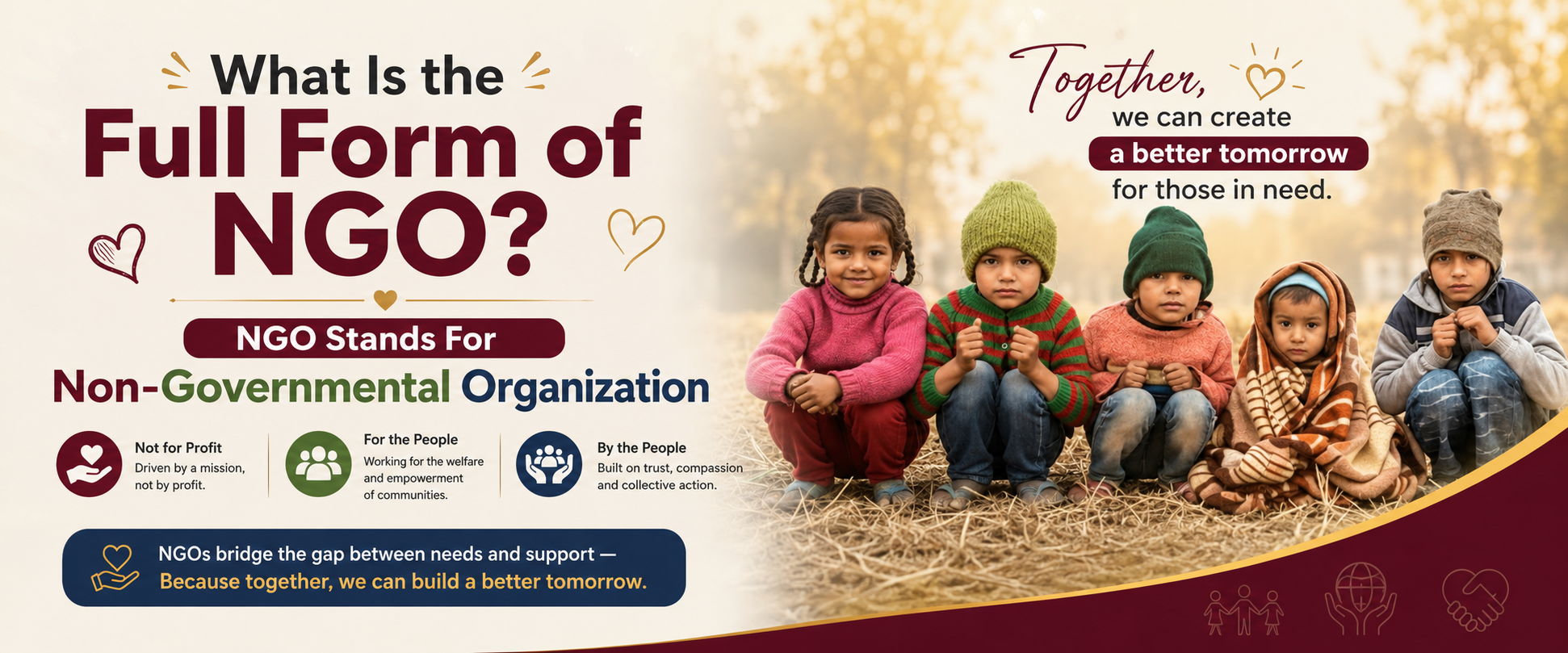
The full form of NGO is Non-Governmental Organization.
Simply speaking, an NGO is a charitable entity that does not rely on government funding, is free from government influence, and operates for the public good in sectors like community upliftment, nature conservation, education, medical care, alleviation of poverty, and other humanitarian areas.
Whenever someone wants to know what is NGO full form, our answer is simply a Non-Governmental Organization which serves the society without earning a profit being its main concern.
What do NGO Full Form and Meaning stand for?
NGO means the organization that is founded by the individual, group or community to handle social, cultural, environmental, or economic issues.
They mainly work at:
- Helping disadvantaged people
- Increasing educational accessibility
- Giving health care support
- Conserving the environment
- Giving power to women and kids
- Uplifting disaster victims
- Spreading knowledge of social problems
Vallabh Sankalp Trust-type organizations pay special attention to achieving long-term social changes through various charitable and community development activities.
Know the Importance of NGOs in India
There are tens of thousands of NGOs in India engaged in different fields. They function as intermediaries between communities and resources, helping people to avail themselves of the opportunities and a robust support system.
Main Roles of NGOs
1. Education Support
Lots of NGOs assist children of poor families in terms of education through grants, educational tools, and sensitization programs.
2. Healthcare Services
NGOs run health camps, provide medical check-ups, organizing blood donation drives, and raise awareness through various programs for the betterment of public health.
3. Community Development
Community development programs are very helpful in providing better facility, sanitation, work opportunity, and other requirements in the most backward areas.
4. Environmental Protection
Environmental protection is a wide concept and has different aspects such as tree plantation, waste management, water conservation and environmental sustainability.
5. Women Empowerment
Empowerment of women is one of the biggest need of the women. In many cases NGOs have made it possible by providing skill training and helping with employment opportunities.
Why Are NGOs Important?
NGOs in fact prove to be the last hope for the people whose problems are not addressed by the authorities through conventional methods.
Benefits of NGOs
- First of all, aid the most disadvantaged groups
- Bring social justice to a community
- Motivate people to participate in volunteering
- Inform people about various significant issues
- Make healthcare and education more accessible
- Assist in overall national development
- Encourage active involvement of the community
Vallabh Sankalp Trust is one such organization that shows the power of willingness combined with hard work in implementing of worthy charity and development activities to make a positive change in society.
Types of NGOs
Every NGO has different mission and role, and some of them work both nationally and internationally.
1. Charitable NGOs
Typically, relief and refuge are provided to the needy through fundraising, welfare schemes, and social works by these institutions.
2. Educational NGOs
NGOs in which education is first and foremost are mainly concerned with reading and writing, skill development and guidance academically.
3. Healthcare NGOs
NGOs that cater to healthcare include promoting accessibility of healthcare, making people aware of healthy living and disease prevention.
4. Environmental NGOs
NGOs that are environmental only, focus on conserving of natural resources, promoting sustainability and involvement in the issues related to climate change.
5. Human Rights NGOs
Human rights NGOs aim at safeguarding individual rights, fighting discrimination and promoting social justice.
How Do NGOs Operate?
There are various ways through which NGOs work. These include:
Donations
Money is donated by the people including individuals, companies, and well-wishers who want to be part of NGO initiatives.
Grants
Grants are given by the government as well as the international organizations for the targeted projects.
Volunteers
Volunteers dedicate their time and work to help NGOs in achieving of their targets.
Corporate Social Responsibility (CSR)
Many organizations presently support NGOs through CSR which are Corporate Social Responsibility activities and partnership projects with NGOs.
NGO Registration in India
For NGOs to function legally, they are commonly registered under one of these entity types:
Trust
A charitable trust is established specifically to carry out social welfare activities.
Society
A society is established under the Societies Registration Act and works mainly towards community based objectives.
Section 8 Company
A Section 8 Company is a type of non-profit organization that works under the umbrella of the Companies Act.
Charitable organizations like Vallabh Sankalp Trust rely on the respective legal frameworks to keep their charitable activities transparent and accountable.
What NGOs Do
Among the main things NGOs do are:
- Helping society at large
- Empowering communities
- Reducing poverty
- Providing more education
- Offering medical support
- Saving the environment
- Empowering women
- Looking after children
- Developing villages
- Providing disaster relief
These goals directly contribute to enhancing the living standards of people and entire communities.
The Positive Role Played By Vallabh Sankalp Trust
The aim of Vallabh Sankalp Trust is to benefit society through efficient projects that change lives and help with community development.
Major areas of work are the following:
- Providing aid to the underprivileged
- Facilitating education
- Raising awareness about health issues
- Conducting social welfare programs
- Helping to develop the community in a positive way
By being persistent in their work, the trust is actively involved in shaping a more equitable and caring society.
To sum up
Just in case you were thinking about what NGO means, it is the abbreviation for Non-Governmental Organization. The role NGOs perform in the social sector is indispensable as they are continuously engaged in efforts to provide better education, healthcare, environmental sustainability, and community welfare.
Knowing the NGO full form gives one a better understanding of the critical role these organizations play, which, in turn, motivates people to get involved in different social issues. One can mention the example of Vallabh Sankalp Trust to illustrate how a local organization is contributing to community empowerment and positive change throughout India.
Frequently Asked Questions (FAQs)
1. What is the full form of NGO?
NGO is a short form for Non-Governmental Organization.
2. What is NGO full form in simple words?
It is an entity that stays independent from the government but works for society and supports different social causes.
3. What is the main purpose of an NGO?
In general, their primary goal is to effect changes in local societies and help individual communities to perform better and have a happier life.
4. Are NGOs non-profit organizations?
Mainly operates on a non-profit basis.
5. How do NGOs receive funding?
Besides other sources of funding, they also receive donations and grants from supporting organizations. Also, corporate social responsibility CSR contributions and fundraising activities are very much a part of their operations.
6. Can anyone start an NGO in India?
Yes, people can start an NGO by registering it legally as the law requires.
7. What are the different types of NGOs?
There are many different types including charities, education, healthcare, environment, and human rights NGOs.
8. Why are NGOs important in society?
In addition to meeting the needs of socially disadvantaged groups and workinglocal level, they alsoplay a crucial role in society throughraising awareness and promoting development.
9. What is the difference between an NGO and a government organization?
Non-government organizations (NGOs) are usually run by volunteers or a board of directors and work to carry out their mission independently from the government. On the contrary, government agencies come under the control and supervision of government authorities/or governments.
10. Do NGOs work internationally?
It is possible some NGOs only operate in their local areas, but there are also hundreds and thousands of NGOs that work at the national and international levels.
11. What is a charitable NGO?
Charitable NGOs generally aim at the betterment of disadvantaged members of the communities through various programs and services.
12. Can students volunteer for NGOs?
It is great that students can take up volunteering work and get hold of the right work attitude. Their active participation in the community initiatives will also benefit the community besides benefiting the students themselves.
13. How do NGOs help in education?
They offer various educational support services and initiatives such as providing scholarships, preparing and distributing instructional materials, conducting awareness campaigns, and offering training and skill development programs.
14. What role does Vallabh Sankalp Trust play in society?
Vallabh Sankalp Trust is a community based organization which spearheads in implementation of social welfare measures through undertakings on education, as well as conducting awareness programs on health and salubrious lifestyles besides other community development initiatives.
15. How can I support an NGO?
You can support an NGO by donating, volunteering, participating in events, or spreading awareness about its mission.